
Skincare has been moving steadily away from one-size-fits-all routines and toward measurement-led personalization. One reason is a growing recognition that chronological age does not always match biological indicators of skin condition. Reviews of intrinsic and extrinsic aging factors highlight how UV exposure, pollution, lifestyle, metabolism, and genetics can shift how skin looks and functions over time.
Against that backdrop, at-home testing tools are emerging to help consumers quantify skin-aging signals rather than relying only on visible changes. One framework being used in this space is SEHI (Skin Epigenetic Hydroxylation Incompetence), a concept developed by Idunn’s Apple to describe a specific type of epigenetic-related decline tied to accelerated skin aging.
What SEHI is described to measure, and why it matters
Idunn’s Apple defines SEHI as a progressive decline in the skin’s ability to carry out hydroxylation-dependent epigenetic modifications (often discussed in the context of DNA and histone regulation) that influence repair, regeneration, and antioxidant defense pathways. In practical terms, SEHI is presented as a measure of how efficiently skin cells “reset” after common stressors such as ultraviolet radiation, pollution exposure, and lifestyle-related oxidative stress.
When this capacity weakens, the theory suggests biological skin age can diverge from chronological age, showing up as earlier or more pronounced changes in hydration, elasticity, tone, and wrinkle formation.
It is also worth noting that while epigenetics and molecular markers are active areas of skin research, SEHI itself is a company-developed construct rather than an established clinical diagnostic category used broadly across dermatology. The usefulness of any framework ultimately depends on whether the measurements are reproducible and meaningfully track outcomes.
How SEHI-based testing works
A SEHI-based self-test is positioned as a noninvasive, rapid assessment of epigenetic-related skin aging signals. The goal is to translate molecular readings into interpretable outputs a consumer can use to guide a regimen.
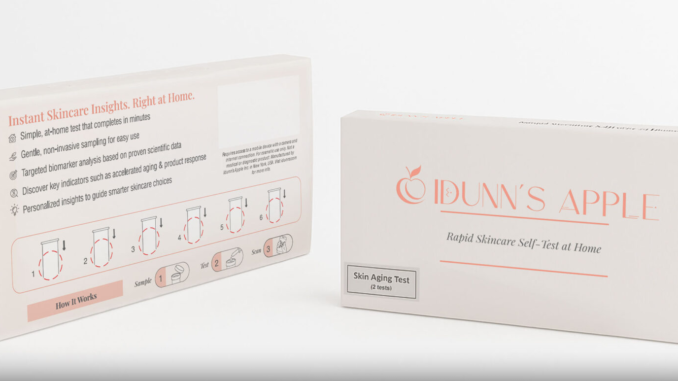
For example, the Idunn’s Apple Skin Aging Self-Test Kit is presented as an at-home test that generates an “immediate report” in minutes and summarizes results in categories such as:
- BioAge fraction (how biologically old the skin behaves relative to norms)
- Accelerated aging level (how fast the skin is aging versus healthy norms)
- Aging-associated skin quality signals (commonly framed around hydration, elasticity, and antioxidant capacity)
These types of outputs align with a broader research trend: separating “clinical” or phenotype-based skin age from chronological age, and exploring whether measurable skin markers can help identify accelerated or decelerated aging patterns.
Why these measurements can change a skincare routine
The practical argument for testing is straightforward: if a person can quantify whether their skin is aging at a typical pace or an accelerated pace, they can choose interventions more deliberately and track whether a routine is actually improving the underlying signals.
In a more conservative framing:
- If results suggest milder imbalance, a user might prioritize antioxidant support and barrier-focused care.
- If results suggest stronger dysfunction under the SEHI framework, a user might consider more targeted approaches designed around that hypothesis.
Idunn’s Apple, for instance, pairs its testing with age-segmented skincare positioning (including its GTA, or “Golden Triple Actives,” concept) as a way to match product selection to measured status rather than to marketing labels like “anti-aging.”
The direction of personalized skincare
The larger story is not just about one test or one brand. It is about a category shift: consumers increasingly want objective feedback loops in skincare, similar to what wearables did for fitness. In that context, SEHI-based self-testing is one attempt to create a repeatable measurement system that can be used at home, then revisited over time to evaluate whether a regimen is helping.
For users who like structured decision-making, the appeal is less “a gadget” and more “a baseline plus a way to measure change.”
References
- R.S. Hussein et al. “Influences on Skin and Intrinsic Aging: Biological, Environmental, and Therapeutic Insights.” Journal of Cosmetic Dermatology (e16688).
- A. Foucher et al. “Clinical vs. chronological skin age: exploring determinants and stratum corneum protein markers of differential skin ageing in 351 healthy women.” Scientific Reports 14:23643 (2024).
- C. Li et al. “Targeting skin epigenetic hydroxylation incompetence: effect of alpha-ketoglutarate, ascorbic acid and gallic acid formula on reducing accelerated skin aging.” Submitted (2025).