
Trauma can leave lasting effects on the body and mind. But could the biological impact of violence reach beyond the people who directly experience it?
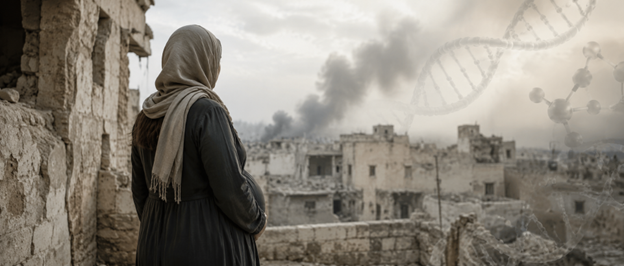
A study from the University of Florida suggests it may. Researchers studying Syrian families found epigenetic differences in the grandchildren of women pregnant during the 1982 Hama massacre, even though those grandchildren had not experienced the violence. The findings offer rare human evidence that extreme stress may leave molecular marks detectable across generations.
“The idea that trauma and violence can have repercussions into future generations should help people be more empathetic,” said senior author of the study Connie Mulligan, Ph.D., professor of anthropology and genetics at the University of Florida. She added that the findings may also help explain “intergenerational cycles of abuse and poverty and trauma.”
Epigenetics refers to chemical changes that influence how genes are turned on or off without changing the DNA sequence itself. One well-known epigenetic mechanism is DNA methylation, in which small chemical groups attach to DNA and help regulate gene activity. These marks can shift in response to age, environment, stress, and other life experiences.
For the study, Mulligan and collaborators Rana Dajani, Ph.D., of Hashemite University in Jordan, and Catherine Panter-Brick, Ph.D., of Yale University, examined three generations of Syrian families living in Jordan. Some families had experienced the Hama massacre before fleeing Syria, while others had lived through the more recent Syrian civil war. A third group had immigrated before 1980 and had not experienced those periods of violence, allowing researchers to compare exposed and unexposed families.
The team collected cheek swabs from 138 people across 48 families, including grandmothers, mothers, and children. Dajani also worked closely with Syrian refugee families in Jordan to build trust and support participation in the study. This design allowed the researchers to look at whether violence exposure during pregnancy or earlier generations was associated with measurable epigenetic changes.
The researchers found 14 regions of the genome that were epigenetically altered in the grandchildren of women who were pregnant during the Hama attack. These grandchildren had not directly experienced the violence, suggesting that stress-related epigenetic signatures may be detectable beyond the exposed generation.
The study also identified 21 epigenetic sites associated with direct exposure to violence. In addition, people exposed to violence while still in the womb showed signs of accelerated epigenetic aging, a measure of biological aging that may be linked to future health risks.
The findings do not mean that trauma changes the DNA sequence itself. Rather, they suggest that extreme stress may alter the regulation of gene expression. It is still unclear whether these epigenetic differences have direct health effects, but previous research has linked stress-related epigenetic changes with conditions such as metabolic health, disease risk, and even the possibility that trauma-related effects can echo across generations.
For the researchers, the study was also about giving families a way to have their experiences recognized. “The families want their story told,” Mulligan said. “They want their experiences heard.”
Importantly, the study also highlights the resilience of the families who participated. While the research points to the deep biological imprint that violence may leave, it also reflects the strength of people who survive trauma, rebuild their lives, and continue family and cultural traditions across generations.
“In the midst of all this violence we can still celebrate their extraordinary resilience,” Mulligan said. “They have persevered.”
This work adds to a growing body of research suggesting that trauma is not only psychological or social, but may also become biologically embedded. Understanding these effects could help researchers, clinicians, and policymakers take the long-term consequences of violence more seriously, not only for survivors but also for future generations.
Source: Mulligan, C.J., Quinn, E.B., Hamadmad, D. et al. Epigenetic signatures of intergenerational exposure to violence in three generations of Syrian refugees. Sci Rep. February 27, 2025.
Resource: Eric Hamilton, University of Florida. Violence alters human genomes for generations, researchers discover. February 27, 2025.