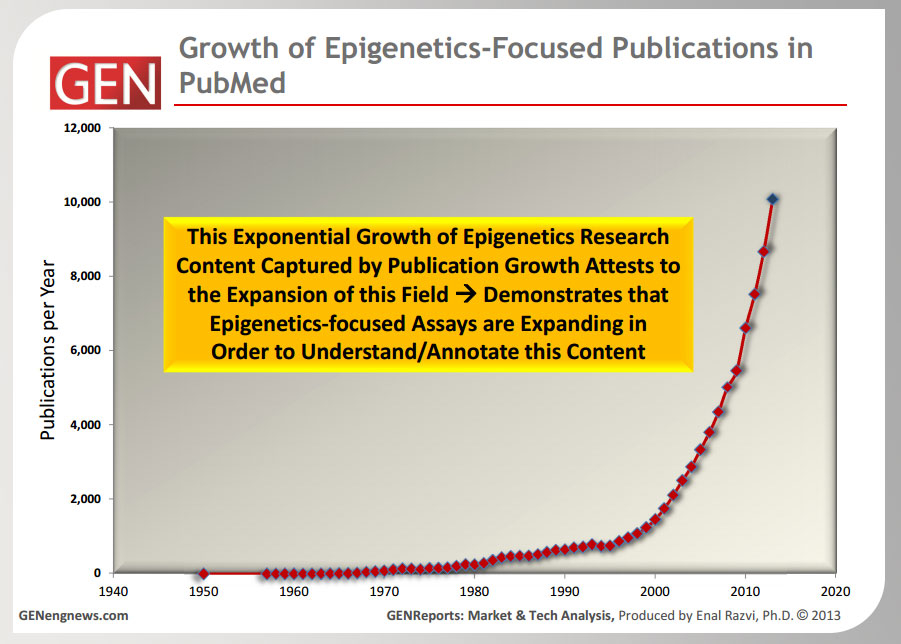
Publication growth in epigenetic-related research attests to the exponential expansion of this field since 2000 according to GENRports (GENReports: Market & Tech Analysis, Produced by Enal Razvi). The yearly published articles related to epigenetics are sharply increased from about 1000 in 2000 to more than 11,000 in 2012 (See Figure: “Growth of Epigenetics-Focused Publications in PubMed”).
Major tools used for epigenetic research in turn are DNA bisulfite conversion method (57%), next-generation sequencing (50%), methylation-related restriction enzymes (49%), histone modification enzyme assays (40%), chromatin immunoprecipitation (38%), DNMT enzyme assays (24%), and methylated DNA immunoprecipitation (18%).
Loss of elasticity is one of the most recognizable signs of skin aging. As skin…
Why can two people encounter the same infection but experience very different symptoms? Age, health,…
CRISPR is best known for cutting and changing DNA. Now, researchers are using the technology…
Skin aging is often described as a normal part of getting older. With time, the…
Age is usually counted in birthdays, but biology does not always follow the calendar. Two…
For years, scientists have studied why some organisms live longer than others. While genes play…