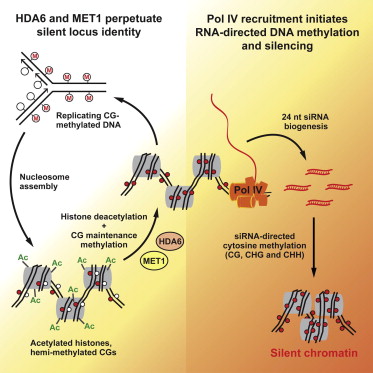
New evidence supports the epigenetic mechanism by which acquired traits may be inherited. The research found that cells silence genes by recognizing chemical tags or marks that are passed down through the generations rather than using information from the hardwired DNA sequences. The chemical tags on the DNA act as a molecular memory which is used by cells to recognize and then silence certain genes in successive generations.
The research, conducted by scientists at Indiana University, illustrates how plant cells direct the silencing of a genetic locus – a specific area on a chromosome where a certain gene can be found – in each new generation.
The cells don’t rely on information gained from the DNA sequence, but rather recall the order to silence particular loci by using chemical tags attached to chromatin, the DNA-protein complex. Chromatin can be modified by adding or removing one-carbon (methyl) or two-carbon (acetyl) chemical marks, processes known as methylation and acetylation, respectively, which forms additional epigenetic information to be interpreted by the cells.
Craig Pikaard, a biochemist and biologist at IU who led the research, calls this pre-established state the “silent locus identity” which acts as a form of epigenetic memory that allows for the continuation of the chromatin marks. During this state, the cell delivers the molecular machinery to carry out silencing to the loci. This is a multistep process called RNA-directed DNA Methylation (RdDM). During RdDM, short-interfering or silencing RNAs (siRNA), small RNA molecules, help add methyl groups to the DNA, ultimately inactivating the genes.
“Importantly, this work shows that silent locus identity is required for, but separable from, actual gene silencing,” Pikaard said. “We’ve found that epigenetic inheritance is a two-step process, with the heritable specification of silent locus identity occurring before actual silencing of the locus can occur.”
Epigenetic inheritance is of interest to scientists because it describes how gene function can be inherited via modifications without alterations to the nucleotide sequence of DNA. Pikaard said the study contributes to the evidence of mechanisms responsible for epigenetic inheritance and helps illuminate the basis for the recruitment of two plant-specific enzymes known to silence genes – the RNA polymerases Pol IV and Pol V – first identified by Pikaard in 1999.
In their study, the researchers assessed the relationship between histone deacetylase 6 (HDA6), an enzyme that removes acetyl groups from histones, and the CG DNA sequence maintenance methyltransferase, MET1. Their collaboration in maintenance methylation, the researchers found, can explain the perpetuation of epigenetic memory that accounts for the state necessary for gene silencing, the silent locus identity.
“Collectively, our results show that silent locus identity is perpetuated from generation to generation through the actions of HDA6 and MET1,” Pikaard said. “These activities are not sufficient to silence the loci but maintain a chromatin state that is required for Pol IV recruitment, siRNA biogenesis and RdDM, which is what ultimately silences the loci.”
Using a plant model, Arabidopsis thaliana (rockcress), the team removed the RdDM pathway in Pol IV and Pol V mutant strains and discovered that the genes were no longer silenced, but the cell’s silent locus identity was still intact. When they removed the HDA6 and MET1-dependent process that establishes silent locus identity they found that the epigenetic tags, or molecular memory, and the cell’s silent locus identity disappeared and could not be regained.
Source: Learn all about it and read more about their findings here: A two-step process for epigenetic inheritance in Arabidopsis. Blevins T, Pontvianne F, Cocklin R, Podicheti R, Chandrasekhara C, Yerneni S, Braun C, Lee B, Rusch D, Mockaitis K, Tang H, Pikaard CS. March 2014.
References: Indiana University. Gene silencing instructions acquired through ‘molecular memory’ tags on chromatin. March 2014.
Loss of elasticity is one of the most recognizable signs of skin aging. As skin…
Why can two people encounter the same infection but experience very different symptoms? Age, health,…
CRISPR is best known for cutting and changing DNA. Now, researchers are using the technology…
Skin aging is often described as a normal part of getting older. With time, the…
Age is usually counted in birthdays, but biology does not always follow the calendar. Two…
For years, scientists have studied why some organisms live longer than others. While genes play…